
What are Overage Charges?

Written by Arnon Shimoni
✓ Expert
Last updated on:
Overage charges are fees applied when a customer exceeds the usage included in their plan or commitment.
For example, if your plan includes 10,000 API calls per month and you make 13,000, the extra 3,000 are overage. You pay for them on top of your plan price, typically at a per-unit rate defined in your contract or pricing page.
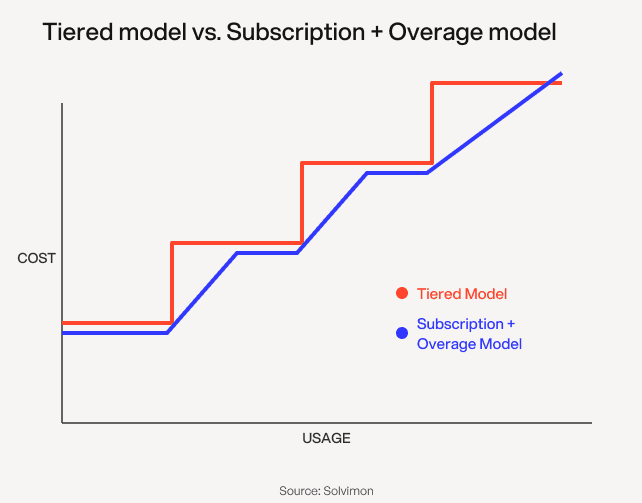
Overages are the mechanism that connects fixed pricing to variable usage. Almost every hybrid pricing model in SaaS includes some form of overage structure, whether it’s billed per unit, charged in pre-purchased blocks, or absorbed through credit burndown.
How overage charges work
The basic structure has three parts: an included allowance, a threshold, and an overage rate.
Component | What it is | Example |
|---|---|---|
Included allowance | The amount of usage bundled into the plan price | 50,000 API calls/month included in the $99 Pro plan |
Threshold | The point at which overage pricing kicks in | Call 50,001 triggers overage billing |
Overage rate | The per-unit price for usage above the threshold | $0.005 per additional API call |
Billing frequency | When overages are calculated and invoiced | End of billing period (monthly), real-time with running balance, or at contract renewal |
Cap (optional) | Maximum overage a customer can incur before being blocked or auto-upgraded | “$500 overage cap per month” or “usage paused at 2x included allowance” |
Some companies bill overages in arrears (at the end of the month after calculating total usage). Others bill in real time against a prepaid credit balance. The choice affects cash flow, customer experience, and billing system requirements.
Overage pricing models
Not all overages work the same way. The structure you choose affects how customers perceive the charge and whether it drives upgrade behavior or creates friction.
Model | How it works | Customer experience | Best for |
|---|---|---|---|
Per-unit overage | Straight per-unit charge for every unit above the allowance. $0.005 per extra API call | Transparent but can create bill shock if usage spikes unexpectedly | Products with predictable, gradual usage growth. API platforms, messaging tools |
Block overage | Overage charged in pre-purchased blocks. Need more than your allowance? Buy another block of 10K calls for $29 | More predictable for the customer. They buy capacity in chunks | Products where usage is lumpy or seasonal. Customers want to control spend proactively |
Tiered overage | Overage rate decreases as overage volume increases. First 10K overage at $0.01, next 50K at $0.008, beyond that at $0.005 | Feels fairer for heavy users. Rewards growth | High-volume products where customers can have 10x usage spikes (data processing, AI) |
Auto-upgrade | No overage charge. Instead, customer is automatically moved to the next plan tier when usage exceeds the current plan | No surprise charges. But customer might not want the higher plan price | PLG products where you want frictionless expansion. Risk: customer churns if auto-upgrade feels forced |
Hard cap | Usage is blocked or throttled when allowance is reached. No overage at all | Customer never gets a surprise bill. But losing access to the product at a critical moment creates frustration | Free tiers, developer sandboxes, budget-sensitive customers who explicitly request spending limits |
Overage charges on a minimum commitment
A minimum commitment sets the floor a customer pays for a period. Overage charges start where that floor ends. Example: a customer commits to €10,000 per month of usage. In March they use €12,400 at contract rates. The invoice shows the €10,000 commit plus €2,400 of overage. Whether the €2,400 is priced at the contract rate or at the list rate depends on the agreement. Contract-rate overage rewards the commit and keeps the customer growing on the same terms. List-rate overage, often 20 to 30% higher, pushes the customer to commit more at renewal. Both are common. What matters for billing is that the commit, the drawdown against it and the overage are rated on one ledger, so the invoice line for overage only appears once the committed amount is used up.
Overage vs true-up
Overage and true-up both settle usage above a commitment. They differ in timing and in what happens when usage is below the commit.
Mechanism | When billed | Who pays if usage is below commit |
|---|---|---|
Overage | Each billing period, on the same invoice as the commit, for usage above the period's included amount | Nobody. The customer pays the commit and the shortfall is forfeited or carried, per contract |
True-up | At the end of the term (or each quarter), one reconciling invoice for the gap between committed and used | The customer pays the shortfall to reach the commit, if the contract has a minimum |
Prepaid drawdown | Up front. Usage draws down the prepaid balance; a top-up or overage invoice follows when the balance hits zero | Nobody. The unused balance expires or rolls over, per contract |
The bill shock problem
Overage charges have a trust problem. When a customer signs up for a $99/month plan and gets a $340 invoice because they went 3x over their API allowance, that’s bill shock. It doesn’t matter that the overage rate was documented on the pricing page. The customer feels ambushed.
Bill shock is the number one source of pricing-related support tickets and one of the top drivers of churn from usage-based and hybrid plans. A customer who gets one surprise bill might stay. A customer who gets two will start looking for alternatives.
Companies that handle overages well do three things. They give customers real-time visibility into their usage relative to their allowance (not end-of-month surprises). They send alerts at 50%, 80%, and 100% of allowance before overage kicks in. And they offer a path to right-size: “You’ve exceeded your plan 3 months in a row. Here’s how upgrading saves you money.”
Approach | What it does | Impact on trust |
|---|---|---|
No visibility, bill at month end | Customer discovers overage on the invoice | Low trust. Creates surprise and resentment |
Email alert at 80% | Customer gets a heads-up before they go over | Medium trust. Appreciated, but not actionable in the moment |
Real-time dashboard + alerts + auto-upgrade option | Customer sees usage live, gets alerts, can choose to upgrade or cap usage | High trust. Customer feels in control of their spend |
Spend caps with explicit opt-in for overage | Usage pauses at the cap. Customer must actively choose to continue and accept overage charges | Highest trust. Customer never pays more than they agreed to. But may lose access at the wrong moment |
Overages and AI products
AI products make the overage question more complicated because usage costs are higher and less predictable than traditional SaaS.
A customer who goes 2x over their API call allowance on a traditional SaaS plan might incur $50 in overage. A customer who goes 2x over their token or credit allowance on an AI product might incur $500 or more, because every token has real inference cost behind it.
This is why most AI products use credit systems rather than raw overage charges. Credits create a prepaid buffer between usage and billing. The customer buys credits upfront, uses them as they go, and tops up when they run low. The overage moment becomes “I need to buy more credits” rather than “I got a surprise bill.” It shifts the purchase decision from reactive (paying for past usage) to proactive (buying future capacity).
The credit model repackages the overage concept rather than eliminating it. When a customer’s credit balance hits zero, something needs to happen: usage stops (hard cap), usage continues and a new credit block is auto-purchased (block overage), or usage continues on pay-as-you-go rates until the next billing cycle (per-unit overage against a credit balance). The billing infrastructure still needs to handle the transition from included to overage, whether that transition is expressed in dollars, credits, or tokens.
Overages and billing infrastructure
Overage billing is where many billing systems start to struggle. Simple subscription platforms handle fixed recurring charges well. Adding metering, threshold detection, real-time alerts, tiered overage rates, mid-cycle plan changes, and prorated charges for partial months turns a simple billing problem into an engineering project.
The companies that handle overages cleanly treat them as a configuration problem, not a code problem. The overage rate, the threshold, the alert triggers, and the cap behavior are all settings in the billing system, not conditional logic in application code. When you need to change the overage rate or add a new tier, it’s a configuration change that finance can make without an engineering ticket.
When overages are hardcoded into application logic, every pricing change requires a deploy, and every new plan requires new conditional branches. Also, every edge case (customer on an old plan with different overage rules) becomes permanent code that someone maintains forever.
This is the operational debt that accumulates when the systems underneath your pricing weren’t built for this level of complexity.
Feeling the complexity? Talk to one of our experts.
Frequently asked questions
What is an overage charge?
An overage charge is the fee for usage above what a plan or commitment includes, billed on top of the plan price at a per-unit rate.
Are overage charges the same as a true-up?
No. Overage is billed every period for usage above the included amount. A true-up is one reconciling invoice at the end of a term that settles the difference between committed and actual usage, in either direction. A contract can have both.
How are overage charges calculated?
Usage above the included amount multiplied by the overage rate. If a plan includes 10,000 calls at €0.01 and the customer uses 13,000, the overage is 3,000 × the overage rate, which may equal the plan rate or a higher list rate.
How do you avoid overage bill shock?
Show usage against the allowance in the product, send alerts at 80% and 100%, cap overage per period where the contract allows, and bill overage at the contract rate rather than a punitive one.
Related
Minimum commit. The floor a customer pays regardless of usage.
Entitlements. What a customer is allowed to use under their plan.
Solvimon usage metering. Real-time metering built into the billing system.
Ready for billing v2?
Solvimon is monetization infrastructure for companies that have outgrown billing v1. One system, entire lifecycle, built by the team that did this at Adyen.